
 By Gareth Johnson
 June 26, 2019
 0
0March 1st Movement
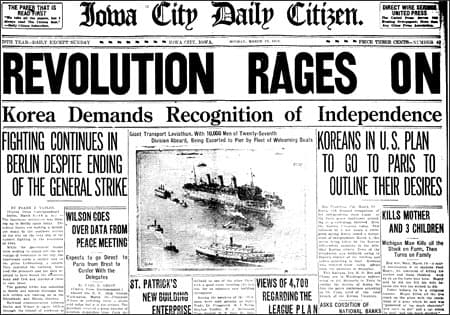
The March 1st Movement, known in both North and South Korea as the Sam-Il Movement (‘Three-One’ Movement, meaning ‘March 1st’ obvs), is named for the first major protest against the unpopular and tyrannical Japanese colonial rule of the Korean peninsula of 1910-1945.
At the end of World War I a great number of new nations sprang from the devastation, and US President Woodrow Wilson declared his belief in the rights of countries to self-determination rather than colonial rule from some distant hegemony (ironic, given the US’s behavior in recent decades). This declaration was something that resonated with and galvanized Korean students of the time.
At 2 pm on March 1st, 1919, thirty-two students took to the streets of Seoul and read out a declaration of independence. According to Wikipedia, the declaration went something like this:
“We herewith proclaim the independence of Korea and the liberty of the Korean people. This we proclaim to all the nations of the world in witness of human equality. This we proclaim to our descendants so that they may enjoy in perpetuity their inherent right to nationhood.”
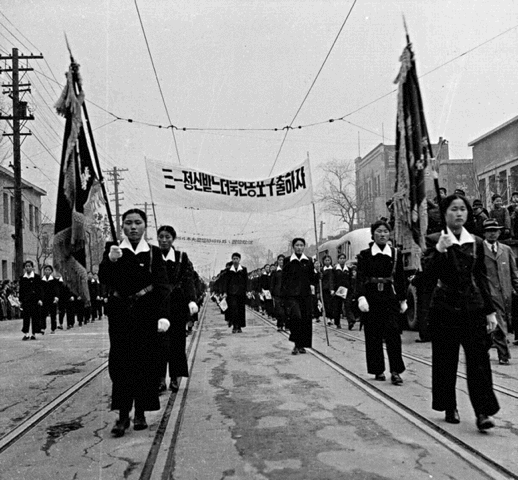
Inasmuch as this proclamation originates from our five-thousand-year history, in as much as it springs from the loyalty of twenty million people, in as much as it affirms our yearning for the advancement of everlasting liberty, in as much as it expresses our desire to take part in the global reform rooted in human conscience, it is the solemn will of heaven, the great tide of our age, and a just act necessary for the co-existence of all humankind. Therefore, no power in this world can obstruct or suppress it!”
The movement gained momentum and, eventually, two million Koreans took part in protests against Japanese rule. Ultimately 100,000 Koreans were killed, wounded or arrested, and many Japanese also died in the protests.
While the protest may be broadly described as a failure (it didn’t result in the immediate liberation of Korea), it certainly fanned the flames of Korean resistance and started Korea down the path of freedom from Japanese rule.
Whilst acknowledged by both Koreas, only in the South is it a public holiday.
Find out more about Korean resistance against Japanese rule yourself on one of our North Korea tours!




Join our newsletter!
Enter your email to receive our latest newsletter.
Don't worry, we don't spam
Popular Articles

Visiting Diriyah the Remarkable Cradle of the Saudi State
Unknown
Uzbek Trains 8211 the Best Network in the World
Unknown
Will the Darvaza Crater be Extinguished by Turkmenistans Government
Unknown
What Are the 10 Largest Stadiums in the World
Unknown
Drone Photography Guidelines in China for 2025
Unknown
Syria Travel Update
Unknown
North Korea to reopen to tourism in Rason
Unknown
YPT now offers free Internet access on all Greenland Svalbard and Antarctica cruises
UnknownRelated Articles


Featured Tours
Afghanistan Spring Tour
8 Nights, 8 DaysStart Date: May 19th 2025
Algeria, Mauritania, Mali and Burkina Faso Combo Tour
26 Nights, 26 DaysStart Date: January 14th 2022
75th Anniversary Party Foundation Day & Mount Kumgang Tour With Mass Games
8 Nights, 8 DaysStart Date: October 8th 2020
All Koreas Part 1: North Korea Borderlands
7 Nights, 7 DaysStart Date: June 13th 2025